Store Offer Menu

  • Image
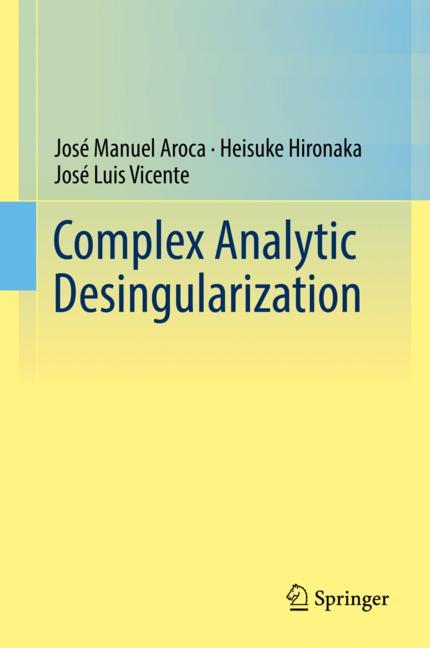
    Complex Analytic Desingularization

    Complex Analytic Desingularization

    Product information for Complex Analytic Desingularization

    153.99
    76.9950% OFF

    [From the foreword by B. Teissier] The main ideas of the proof of resolution of singularities of complex-analytic spaces presented here were developed by Heisuke Hironaka in the late 1960s and early 1970s. Since then, a number of proofs, all inspired by Hironaka's general approach, have appeared, the validity of some of them extending beyond the complex analytic case. The proof has now been so streamlined that, although it was seen 50 years ago as one of the most difficult proofs produced by mathematics, it can now be the subject of an advanced university course. Yet, far from being of historical interest only, this long-awaited book will be very rewarding for any mathematician interested in singularity theory. Rather than a proof of a canonical or algorithmic resolution of singularities, what is presented is in fact a masterly study of the infinitely near “worst” singular points of a complex analytic space obtained by successive “permissible” blowing ups and of the way to tame them using certain subspaces of the ambient space. This taming proves by an induction on the dimension that there exist finite sequences of permissible blowing ups at the end of which the worst infinitely near points have disappeared, and this is essentially enough to obtain resolution of singularities. Hironaka’s ideas for resolution of singularities appear here in a purified and geometric form, in part because of the need to overcome the globalization problems appearing in complex analytic geometry. In addition, the book contains an elegant presentation of all the prerequisites of complex analytic geometry, including basic definitions and theorems needed to follow the development of ideas and proofs. Its epilogue presents the use of similar ideas in the resolution of singularities of complex analytic foliations. This text will be particularly useful and interesting for readers of the younger generation who wish to understand one of the most fundamental results in algebraic and analytic geometry and invent possible extensions and applications of the methods created to prove it.

  • More Deals You’ll Love

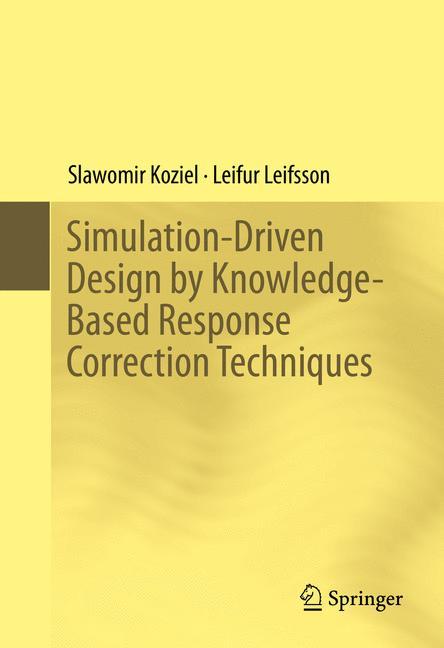
    Simulation-Driven Design by Knowledge-Based Response Correction Techniques
    Springer Shop logo

    Simulation-Driven Design by Knowledge-Based Respon...

    Focused on efficient simulation-driven multi-fidelity optimization techniques, this monograph on simulation-driven optimization covers simulations utilizing physics-based low-fidelity models, often based on coarse-discretization simulations or other types of simplified physics representations, such as analytical models. The methods presented in the book exploit as much as possible any knowledge about the system or device of interest embedded in the low-fidelity model with the purpose of reducing the computational overhead of the design process. Most of the techniques described in the book are of response correction type and can be split into parametric (usually based on analytical formulas) and non-parametric, i.e., not based on analytical formulas. The latter, while more complex in implementation, tend to be more efficient. The book presents a general formulation of response correction techniques as well as a number of specific methods, including those based on correcting the low-fidelity model response (output space mapping, manifold mapping, adaptive response correction and shape-preserving response prediction), as well as on suitable modification of design specifications. Detailed formulations, application examples and the discussion of advantages and disadvantages of these techniques are also included. The book demonstrates the use of the discussed techniques for solving real-world engineering design problems, including applications in microwave engineering, antenna design, and aero/hydrodynamics.
    54.99
    27.4950% OFF
    Measure and Integral
    Springer Shop logo

    Measure and Integral

    The Lebesgue integral is an essential tool in the fields of analysis and stochastics and for this reason, in many areas where mathematics is applied. This textbook is a concise, lecture-tested introduction to measure and integration theory. It addresses the important topics of this theory and presents additional results which establish connections to other areas of mathematics. The arrangement of the material should allow the adoption of this textbook in differently composed Bachelor programmes.
    43.99
    21.9950% OFF
    Encyclopedia of Distances
    Springer Shop logo

    Encyclopedia of Distances

    This 4-th edition of the leading reference volume on distance metrics is characterized by updated and rewritten sections on some items suggested by experts and readers, as well a general streamlining of content and the addition of essential new topics. Though the structure remains unchanged, the new edition also explores recent advances in the use of distances and metrics for e.g. generalized distances, probability theory, graph theory, coding theory, data analysis. New topics in the purely mathematical sections include e.g. the Vitanyi multiset-metric, algebraic point-conic distance, triangular ratio metric, Rossi-Hamming metric, Taneja distance, spectral semimetric between graphs, channel metrization, and Maryland bridge distance. The multidisciplinary sections have also been supplemented with new topics, including: dynamic time wrapping distance, memory distance, allometry, atmospheric depth, elliptic orbit distance, VLBI distance measurements, the astronomical system of units, and walkability distance. Leaving aside the practical questions that arise during the selection of a ‘good’ distance function, this work focuses on providing the research community with an invaluable comprehensive listing of the main available distances. As well as providing standalone introductions and definitions, the encyclopedia facilitates swift cross-referencing with easily navigable bold-faced textual links to core entries. In addition to distances themselves, the authors have collated numerous fascinating curiosities in their Who’s Who of metrics, including distance-related notions and paradigms that enable applied mathematicians in other sectors to deploy research tools that non-specialists justly view as arcane. In expanding access to these techniques, and in many cases enriching the context of distances themselves, this peerless volume is certain to stimulate fresh research.
    241.99
    120.9950% OFF
    Reduced-Order Modeling (ROM) for Simulation and Optimization
    Springer Shop logo

    Reduced-Order Modeling (ROM) for Simulation and Op...

    This edited monograph collects research contributions and addresses the advancement of efficient numerical procedures in the area of model order reduction (MOR) for simulation, optimization and control. The topical scope includes, but is not limited to, new out-of-the-box algorithmic solutions for scientific computing, e.g. reduced basis methods for industrial problems and MOR approaches for electrochemical processes. The target audience comprises research experts and practitioners in the field of simulation, optimization and control, but the book may also be beneficial for graduate students alike. 
    72.75
    25.6765% OFF
    Geometry in History
    Springer Shop logo

    Geometry in History

    This is a collection of surveys on important mathematical ideas, their origin, their evolution and their impact in current research. The authors are mathematicians who are leading experts in their fields. The book is addressed to all mathematicians, from undergraduate students to senior researchers, regardless of the specialty.
    111.27
    38.5165% OFF
    Basic Algebraic Topology and its Applications
    Springer Shop logo

    Basic Algebraic Topology and its Applications

    This book provides an accessible introduction to algebraic topology, a field at the intersection of topology, geometry and algebra, together with its applications. Moreover, it covers several related topics that are in fact important in the overall scheme of algebraic topology. Comprising eighteen chapters and two appendices, the book integrates various concepts of algebraic topology, supported by examples, exercises, applications and historical notes. Primarily intended as a textbook, the book offers a valuable resource for undergraduate, postgraduate and advanced mathematics students alike. Focusing more on the geometric than on algebraic aspects of the subject, as well as its natural development, the book conveys the basic language of modern algebraic topology by exploring homotopy, homology and cohomology theories, and examines a variety of spaces: spheres, projective spaces, classical groups and their quotient spaces, function spaces, polyhedra, topological groups, Lie groups and cell complexes, etc. The book studies a variety of maps, which are continuous functions between spaces. It also reveals the importance of algebraic topology in contemporary mathematics, theoretical physics, computer science, chemistry, economics, and the biological and medical sciences, and encourages students to engage in further study.
    94.50
    47.1850% OFF
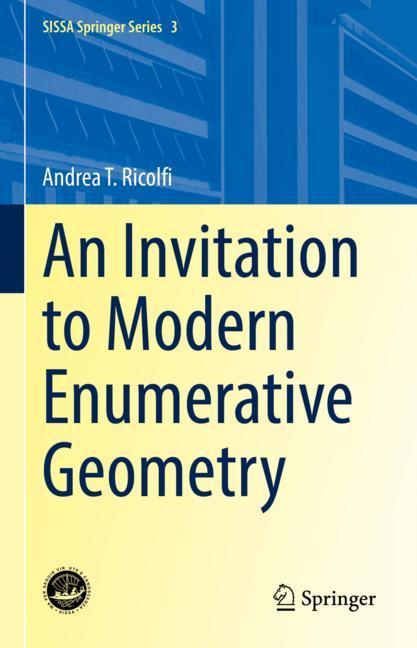
    An Invitation to Modern Enumerative Geometry
    Springer Shop logo

    An Invitation to Modern Enumerative Geometry

    This book is based on a series of lectures given by the author at SISSA, Trieste, within the PhD courses Techniques in enumerative geometry (2019) and Localisation in enumerative geometry (2021). The goal of this book is to provide a gentle introduction, aimed mainly at graduate students, to the fast-growing subject of enumerative geometry and, more specifically, counting invariants in algebraic geometry. In addition to the more advanced techniques explained and applied in full detail to concrete calculations, the book contains the proofs of several background results, important for the foundations of the theory. In this respect, this text is conceived for PhD students or research “beginners” in the field of enumerative geometry or related areas. This book can be read as an introduction to Hilbert schemes and Quot schemes on 3-folds but also as an introduction to localisation formulae in enumerative geometry. It is meant to be accessible without a strong background in algebraic geometry; however, three appendices (one on deformation theory, one on intersection theory, one on virtual fundamental classes) are meant to help the reader dive deeper into the main material of the book and to make the text itself as self-contained as possible.
    132.50
    66.5050% OFF
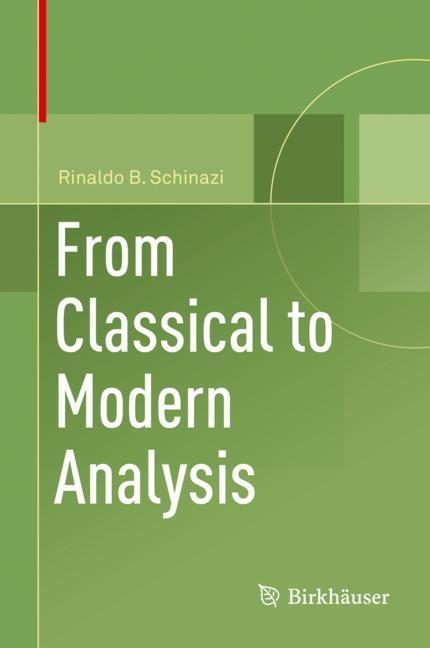
    From Classical to Modern Analysis
    Springer Shop logo

    From Classical to Modern Analysis

    This innovative textbook bridges the gap between undergraduate analysis and graduate measure theory by guiding students from the classical foundations of analysis to more modern topics like metric spaces and Lebesgue integration. Designed for a two-semester introduction to real analysis, the text gives special attention to metric spaces and topology to familiarize students with the level of abstraction and mathematical rigor needed for graduate study in real analysis. Fitting in between analysis textbooks that are too formal or too casual, From Classical to Modern Analysis is a comprehensive, yet straightforward, resource for studying real analysis. To build the foundational elements of real analysis, the first seven chapters cover number systems, convergence of sequences and series, as well as more advanced topics like superior and inferior limits, convergence of functions, and metric spaces. Chapters 8 through 12 explore topology in and continuityon metric spaces and introduce the Lebesgue integrals. The last chapters are largely independent and discuss various applications of the Lebesgue integral. Instructors who want to demonstrate the uses of measure theory and explore its advanced applications with their undergraduate students will find this textbook an invaluable resource. Advanced single-variable calculus and a familiarity with reading and writing mathematical proofs are all readers will need to follow the text. Graduate students can also use this self-contained and comprehensive introduction to real analysis for self-study and review.
    77.00
    38.9249% OFF
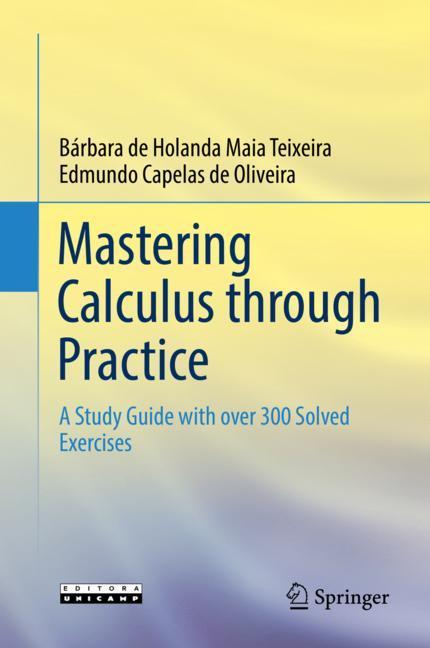
    Mastering Calculus through Practice
    Springer Shop logo

    Mastering Calculus through Practice

    This textbook covers key topics of Elementary Calculus through selected exercises, in a sequence that facilitates development of problem-solving abilities and techniques. It opens with an introduction to fundamental facts of mathematical logic, set theory, and pre-calculus, extending toward functions, limits, derivatives, and integrals. Over 300 solved problems are approached with a simple, direct style, ordered in a way that positively challenges students and helps them build self-confidence as they progress. A special final chapter adds five carefully crafted problems for a comprehensive recap of the work. The book is aimed at first-year students of fields in which calculus and its applications have a role, including Science, Technology, Engineering, Mathematics, Economics, Architecture, Management, and Applied Social Sciences, as well as students of Quantitative Methods courses. It can also serve as rich supplementary reading for self-study.
    42.79
    21.3950% OFF
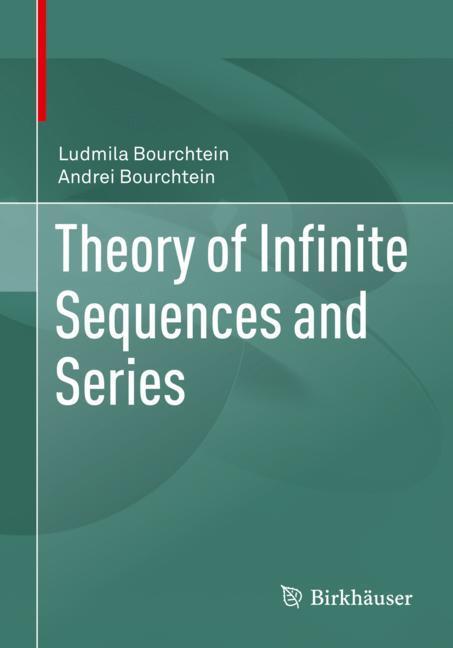
    Theory of Infinite Sequences and Series
    Springer Shop logo

    Theory of Infinite Sequences and Series

    This textbook covers the majority of traditional topics of infinite sequences and series, starting from the very beginning – the definition and elementary properties of sequences of numbers, and ending with advanced results of uniform convergence and power series. The text is aimed at university students specializing in mathematics and natural sciences, and at all the readers interested in infinite sequences and series. It is designed for the reader who has a good working knowledge of calculus. No additional prior knowledge is required. The text is divided into five chapters, which can be grouped into two parts: the first two chapters are concerned with the sequences and series of numbers, while the remaining three chapters are devoted to the sequences and series of functions, including the power series. Within each major topic, the exposition is inductive and starts with rather simple definitions and/or examples, becoming more compressed and sophisticated as the course progresses. Each key notion and result is illustrated with examples explained in detail. Some more complicated topics and results are marked as complements and can be omitted on a first reading. The text includes a large number of problems and exercises, making it suitable for both classroom use and self-study. Many standard exercises are included in each section to develop basic techniques and test the understanding of key concepts. Other problems are more theoretically oriented and illustrate more intricate points of the theory, or provide counterexamples to false propositions which seem to be natural at first glance. Solutions to additional problems proposed at the end of each chapter are provided as an electronic supplement to this book.
    51.35
    25.6750% OFF
    Optimal Transport and Applications to Geometric Optics
    Springer Shop logo

    Optimal Transport and Applications to Geometric Op...

    This book concerns the theory of optimal transport (OT) and its applications to solving problems in geometric optics. It is a self-contained presentation including a detailed analysis of the Monge problem, the Monge-Kantorovich problem, the transshipment problem, and the network flow problem. A chapter on Monge-Ampère measures is included containing also exercises. A detailed analysis of the Wasserstein metric is also carried out. For the applications to optics, the book describes the necessary background concerning light refraction, solving both far-field and near-field refraction problems, and indicates lines of current research in this area. Researchers in the fields of mathematical analysis, optimal transport, partial differential equations (PDEs), optimization, and optics will find this book valuable. It is also suitable for graduate students studying mathematics, physics, and engineering. The prerequisites for this book include a solid understanding of measure theory and integration, as well as basic knowledge of functional analysis.
    38.51
    19.6849% OFF
    Robust Multivariate Analysis
    Springer Shop logo

    Robust Multivariate Analysis

    This text presents methods that are robust to the assumption of a multivariate normal distribution or methods that are robust to certain types of outliers. Instead of using exact theory based on the multivariate normal distribution, the simpler and more applicable large sample theory is given. The text develops among the first practical robust regression and robust multivariate location and dispersion estimators backed by theory. The robust techniques are illustrated for methods such as principal component analysis, canonical correlation analysis, and factor analysis. A simple way to bootstrap confidence regions is also provided. Much of the research on robust multivariate analysis in this book is being published for the first time. The text is suitable for a first course in Multivariate Statistical Analysis or a first course in Robust Statistics. This graduate text is also useful for people who are familiar with the traditional multivariate topics, but want to know more about handling data sets with outliers. Many R programs and R data sets are available on the author’s website.
    87.99
    43.9950% OFF
    Fuzzy Operator Theory in Mathematical Analysis
    Springer Shop logo

    Fuzzy Operator Theory in Mathematical Analysis

    This self-contained monograph presents an overview of fuzzy operator theory in mathematical analysis. Concepts, principles, methods, techniques, and applications of fuzzy operator theory are unified in this book to provide an introduction to graduate students and researchers in mathematics, applied sciences, physics, engineering, optimization, and operations research. New approaches to fuzzy operator theory and fixed point theory with applications to fuzzy metric spaces, fuzzy normed spaces, partially ordered fuzzy metric spaces, fuzzy normed algebras, and non-Archimedean fuzzy metric spaces are presented. Surveys are provided on: Basic theory of fuzzy metric and normed spaces and its topology, fuzzy normed and Banach spaces, linear operators, fundamental theorems (open mapping and closed graph), applications of contractions and fixed point theory, approximation theory and best proximity theory, fuzzy metric type space, topology and applications.
    131.99
    65.9950% OFF
    Data Analysis for Direct Numerical Simulations of Turbulent Combustion
    Springer Shop logo

    Data Analysis for Direct Numerical Simulations of ...

    This book presents methodologies for analysing large data sets produced by the direct numerical simulation (DNS) of turbulence and combustion. It describes the development of models that can be used to analyse large eddy simulations, and highlights both the most common techniques and newly emerging ones. The chapters, written by internationally respected experts, invite readers to consider DNS of turbulence and combustion from a formal, data-driven standpoint, rather than one led by experience and intuition. This perspective allows readers to recognise the shortcomings of existing models, with the ultimate goal of quantifying and reducing model-based uncertainty. In addition, recent advances in machine learning and statistical inferences offer new insights on the interpretation of DNS data. The book will especially benefit graduate-level students and researchers in mechanical and aerospace engineering, e.g. those with an interest in general fluid mechanics,applied mathematics, and the environmental and atmospheric sciences.
    171.19
    85.5950% OFF
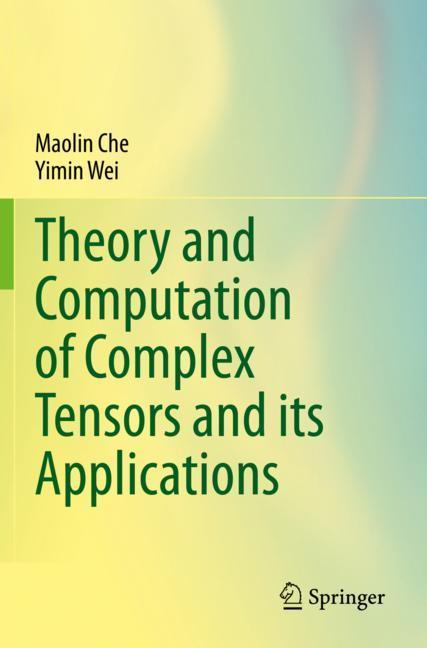
    Theory and Computation of Complex Tensors and its Applications
    Springer Shop logo

    Theory and Computation of Complex Tensors and its ...

    The book provides an introduction of very recent results about the tensors and mainly focuses on the authors' work and perspective. A systematic description about how to extend the numerical linear algebra to the numerical multi-linear algebra is also delivered in this book. The authors design the neural network model for the computation of the rank-one approximation of real tensors, a normalization algorithm to convert some nonnegative tensors to plane stochastic tensors and a probabilistic algorithm for locating a positive diagonal in a nonnegative tensors, adaptive randomized algorithms for computing the approximate tensor decompositions, and the QR type method for computing U-eigenpairs of complex tensors. This book could be used for the Graduate course, such as Introduction to Tensor. Researchers may also find it helpful as a reference in tensor research.
    142.00
    70.7850% OFF
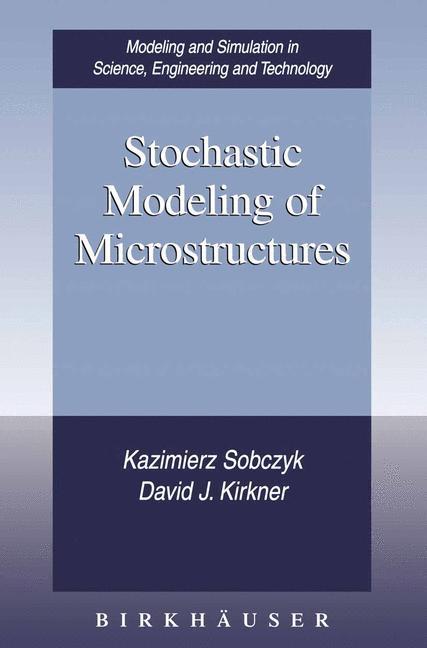
    Stochastic Modeling of Microstructures
    Springer Shop logo

    Stochastic Modeling of Microstructures

    A major challenge in applied mathematics and mechanics of materials is to describe various types of material microstructures. The details of the microstructure of most natural and engineered materials are usually obscure; uncertainty and randomness are the inherent features. This complexity due to material heterogeneity has not been A major challenge in applied mathematics and mechanics of materials is to describe various types of material microstructures. The details of the microstructure of most natural and engineered materials are usually obscure; uncertainty and randomness are the inherent features. This complexity due to material heterogeneity has not been adequately described by current classical models and theories. Stochastic Modeling of Microstructures presents a concise and unified presentation of the basic principles and tools for the modeling of real materials, natural and man-made, that possess complex, random heterogeneity. The book uses the language and methods of random field theory combined with the basic constructs of stochastic geometry and geometrical/spatial statistics in order to give the reader the knowledge necessary to model various types of material microstructures. The application of the theoretical constructs reviewed in the first three chapters to the analysis of empirical data via the tools of statistical inference is also discussed. The final chapters address practical aspects of specific modeling problems. Features- ú First comprehensive introduction to the comparatively new field of stochastic modeling of material microstructures ú Presentation of basic tools required from the diverse subjects of random field theory, stochastic geometry and spatial statistics ú Provides background concepts from probability theory and stochastic processes are provided ú Applications from various fields are discussed, including stochastic wave propagation and the mechanics of
    42.79
    13.9967% OFF
    Markov Chains and Invariant Probabilities
    Springer Shop logo

    Markov Chains and Invariant Probabilities

    This book is about discrete-time, time-homogeneous, Markov chains (Mes) and their ergodic behavior. To this end, most of the material is in fact about stable Mes, by which we mean Mes that admit an invariant probability measure. To state this more precisely and give an overview of the questions we shall be dealing with, we will first introduce some notation and terminology. Let (X,B) be a measurable space, and consider a X-valued Markov chain ~. = {~k' k = 0, 1, ... } with transition probability function (t.pJ.) P(x, B), i.e., P(x, B) := Prob (~k+1 E B I ~k = x) for each x E X, B E B, and k = 0,1, .... The Me ~. is said to be stable if there exists a probability measure (p.m.) /.l on B such that (*) VB EB. /.l(B) = Ix /.l(dx) P(x, B) If (*) holds then /.l is called an invariant p.m. for the Me ~. (or the t.p.f. P).
    42.79
    13.9967% OFF
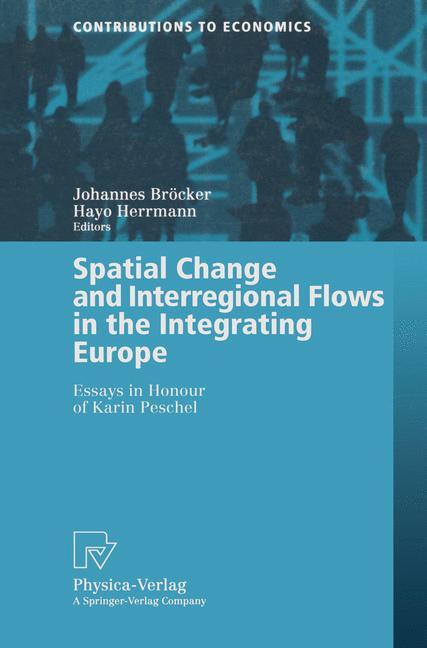
    Spatial Change and Interregional Flows in the Integrating Europe
    Springer Shop logo

    Spatial Change and Interregional Flows in the Inte...

    Within the broad frame of regional research in an international perspective, the contributions of this volume present new theoretical, methodological and empirical results as well as political strategies for the following topics: - ecomomic integration in the Baltic rim, - innovation and regional growth, - economic integration, trade and migration, - transport infrastructure and the regions. Most of the topics deal with the long-term integration process in Europe, with a particular focus on the North European and Baltic Sea integration.
    42.79
    13.9967% OFF
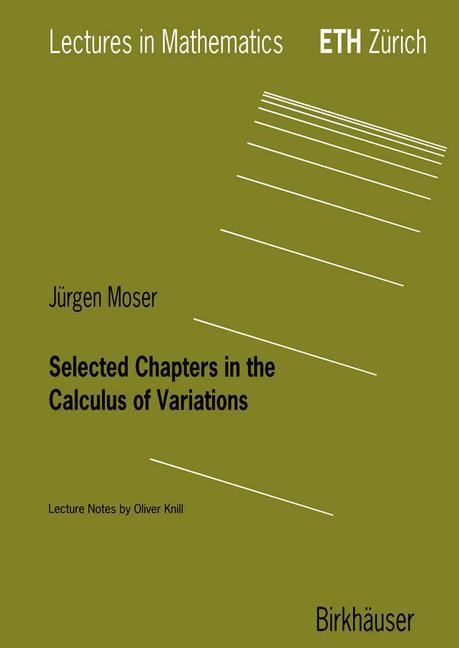
    Selected Chapters in the Calculus of Variations
    Springer Shop logo

    Selected Chapters in the Calculus of Variations

    0.1 Introduction These lecture notes describe a new development in the calculus of variations which is called Aubry-Mather-Theory. The starting point for the theoretical physicist Aubry was a model for the descrip­ tion of the motion of electrons in a two-dimensional crystal. Aubry investigated a related discrete variational problem and the corresponding minimal solutions. On the other hand, Mather started with a specific class of area-preserving annulus mappings, the so-called monotone twist maps. These maps appear in mechanics as Poincare maps. Such maps were studied by Birkhoff during the 1920s in several papers. In 1982, Mather succeeded to make essential progress in this field and to prove the existence of a class of closed invariant subsets which are now called Mather sets. His existence theorem is based again on a variational principle. Although these two investigations have different motivations, they are closely re­ lated and have the same mathematical foundation. We will not follow those ap­ proaches but will make a connection to classical results of Jacobi, Legendre, Weier­ strass and others from the 19th century. Therefore in Chapter I, we will put together the results of the classical theory which are the most important for us. The notion of extremal fields will be most relevant. In Chapter II we will investigate variational problems on the 2-dimensional torus. We will look at the corresponding global minimals as well as at the relation be­ tween minimals and extremal fields. In this way, we will be led to Mather sets.
    47.00
    13.9970% OFF
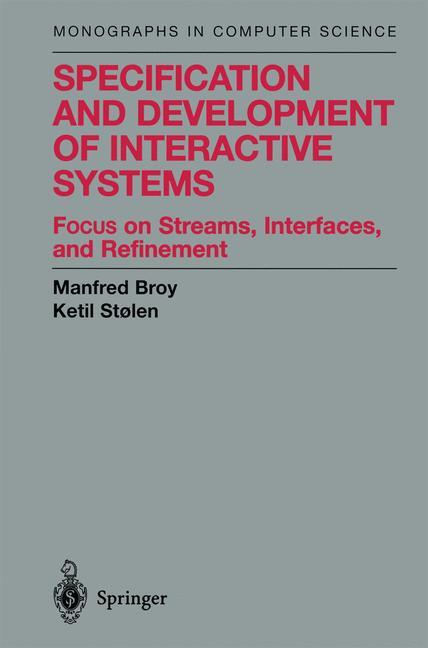
    Specification and Development of Interactive Systems
    Springer Shop logo

    Specification and Development of Interactive Syste...

    This book presents a fundamental mathematical and logical approach to soft­ ware and systems engineering. Considering the large number of books de­ scribing mathematical approaches to program development, it is important to explain what we consider to be the specific contribution of our book, to identify our goals, and to characterize our intended target audience. Most books dealing with the mathematics and logics of programming and system development are mainly devoted to programming in the small. This is in contrast to our book where the emphasis is on modular system development with the help of component specifications with precisely identified interfaces and refinement concepts. Our book aims at systems development carried out in a systematic way, based on a clear mathematical theory. We do not claim that this book presents a full-blown engineering method. In fact, this is certainly not a book for the application-driven software engi­ neer looking for a practical method for system development in an industrial context. It is much rather a book for the computer scientist and the scientifi­ cally interested engineer who looks for basic principles of system development and, moreover, its mathematical foundations. It is also a book for method builders interested in a proper mathematical foundation on which they can build a practical development method and industrial-strength support tools.
    47.00
    13.9970% OFF
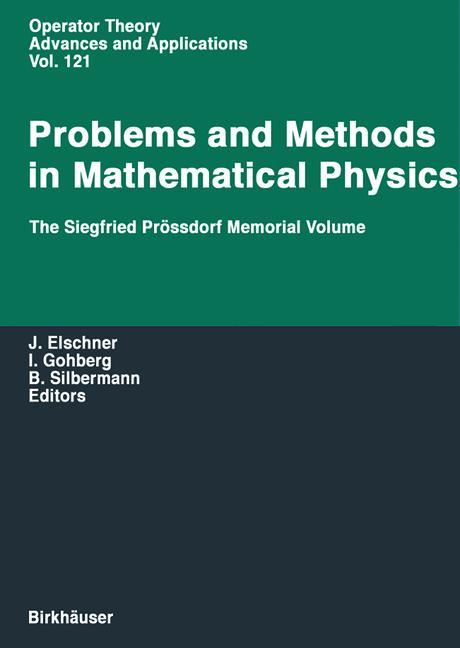
    Problems and Methods in Mathematical Physics
    Springer Shop logo

    Problems and Methods in Mathematical Physics

    This volume presents the proceedings of the 11th Conference on Problems and Methods in Mathematical Physics (11th TMP), held in Chemnitz, March 25-28, 1999. The conference was dedicated to the memory of Siegfried Prössdorf, who made important contributions to the theory and numerical analysis of operator equations and their applications in mathematical physics and mechanics. The main part of the book comprises original research papers. The topics are ranging from integral and pseudodifferential equations, boundary value problems, operator theory, boundary element and wavelet methods, approximation theory and inverse problems to various concrete problems and applications in physics and engineering, and reflect Prössdorf's broad spectrum of research activities. The volume also contains articles describing the life and mathematical achievements of Siegfried Prössdorf and includes a list of his publications. The book is addressed to a wide audience in the mathematical and engineering sciences.
    47.00
    13.9970% OFF

    Subscribe to Springer Shop coupon newsletter

    Get notified of offers and coupon codes from Springer Shop before they expire!